
What property tax exemptions can I get in Volusia County?
Volusia County's homestead exemption removes up to $51,411 in 2026 ($25,000 base plus a $26,411 additional exemption, indexed annually for inflation) from your primary home's assessed value and caps annual assessment increases at 3% under Save Our Homes. Additional exemptions may apply for seniors, veterans, and surviving spouses. You file one application with the Volusia County Property Appraiser by the March 1 deadline.
Volusia 2026 property tax breakdown — millage by city, $51K homestead Mar 1 deadline, Save Our Homes cap explained.

Serving Port Orange, New Smyrna Beach, Daytona Beach, Daytona Beach Shores, Ormond Beach, Ponce Inlet, Edgewater, South Daytona, DeLand & Deltona
Thinking of selling? Your tax bill is only part of the picture. See how much it costs to sell a house in Florida and how insurance and roof age affect your sale price.
2026 Update — April 2026: This guide has been updated for 2026 with current millage rates by city, the homestead exemption deadline, Save Our Homes cap rules, and a worked example for a $450,000 Port Orange home. Out-of-state buyers especially: scroll to the section on "Save Our Homes Reset" — your tax bill will not match what the seller has been paying.
📄 Free: Volusia County Cost-of-Living Comparison
11 cities × 14 real cost dimensions, 2026 numbers. Tell me where to send it and it is yours — free, no obligation.
Email Me the Free Guide →2026 Volusia County Millage Rates by City
These are the typical combined millage rates for owner-occupied homes in 2026. Verify your specific parcel's millage at vcpa.vcgov.org.
These are the rates adopted for fiscal year 2025-26, rounded. Your parcel's exact rate runs to four decimals and depends on which fire, school, and special districts you sit in. Rates for the next tax year aren't final yet. The county held its final budget hearing on September 22, 2026, and the school board adopted 5.243 mills on September 8 (down from 5.279). Several cities hold their final votes in late September, so I'll update this table in early October once every rate is final.
What Amendment 3 Could Change in 2027
There's a property tax amendment on your November 2026 ballot, and it's the single most common question I'm getting from buyers right now. Here's the plain version.
The Legislature voted on June 2, 2026 to put it in front of voters. If it passes with the required 60%, the homestead exemption on non-school taxes goes from today's $51,411 to $150,000 on January 1, 2027, then $250,000 on January 1, 2028.
Three things people keep getting wrong about it:
School taxes are not included. Volusia's school millage is 5.279 mills — roughly a quarter to a third of your bill depending on your city — and it wouldn't move. Nobody's property tax bill goes to zero.
Nothing changes for the 2026 tax year. The bill arriving in your mailbox this November is calculated under today's rules. The earliest any of this shows up is your 2027 bill.
It only applies to homesteaded primary residences. Second homes, snowbird condos, and rentals don't get it.
If you're buying this year, budget using the current numbers below. Treat anything Amendment 3 might save you as a bonus, not a plan.
Homestead Exemption in Daytona Beach, DeLand & Deltona: Who Qualifies and How to File
If your Volusia County home is your permanent residence as of January 1, you can claim Florida's homestead exemption no matter which city you live in — Daytona Beach, Port Orange, DeLand, Deltona, Ormond Beach, New Smyrna Beach, Edgewater or Ponce Inlet. You file once with the Volusia County Property Appraiser (not your city), and the exemption then lowers the taxable value used by every taxing authority on your bill.
The homestead exemption removes up to $51,411 (2026 maximum — $25,000 base plus a $26,411 additional exemption, indexed annually for inflation) from your home's assessed value and locks in the Save Our Homes cap, which limits future assessment increases to 3% per year (or the change in CPI, whichever is lower). Here is exactly how the 2026 maximum of $51,411 is applied:
Apply the millage from the 2026 Volusia County Millage Rates by City table above to that $51,411 and most homesteaded owners save roughly $700–$950 a year — every year they own the home. The deadline to file is March 1, and once approved the exemption renews automatically. If you moved within Florida, you may also carry up to $500,000 of your prior Save Our Homes savings to your new Volusia home through portability. For a click-by-click walkthrough, see How to File Your Volusia County Homestead Exemption Online, and if you are buying in the area, start with our Daytona Beach homes guide.
Volusia County Property Tax & Homestead FAQ
What is the homestead exemption in Daytona Beach and Volusia County?
It is a Florida tax break that removes up to $51,411 (2026 maximum, indexed annually for inflation) from the assessed value of your permanent residence and caps annual assessment increases at 3% under Save Our Homes. The same rules apply in Daytona Beach, Port Orange, DeLand, Deltona and every other Volusia city — you file one application with the Volusia County Property Appraiser.
What is the effective property tax rate in Volusia County for 2026?
For a homesteaded primary residence, Volusia County's effective property tax rate averages just under 1% of market value (roughly 0.9%–1.0%). Your exact rate depends on your city's combined millage — see the city-by-city table earlier in this guide.
When is the Volusia County homestead exemption deadline?
March 1 of the tax year. You must have owned and occupied the home as your permanent residence as of January 1. File anytime before March 1 with the Volusia County Property Appraiser; late applications may be considered but are not guaranteed.
Does the homestead exemption lower my mortgage payment?
Indirectly, yes. If your property taxes are paid through an escrow account, a lower tax bill reduces what your lender collects, which can lower your monthly escrow payment after the next escrow analysis. It does not change your loan's principal or interest rate.
How do I file for homestead exemption in DeLand or Deltona?
The process is identical countywide: apply online or in person with the Volusia County Property Appraiser, whether your home is in DeLand, Deltona or anywhere else in the county. Our step-by-step guide covers the online filing in detail: File Your Volusia County Homestead Exemption Online.
Your tax bill is based on assessed value — what’s your home actually worth?
Get a free, instant estimate from live comparable sales. Most Volusia owners are surprised by the gap between assessed and market value.
What’s My Home Worth? →Free Insurance & Roof-Age Worksheet →
The Save Our Homes Reset (Out-of-State Buyers Read This)
Your property tax bill will NOT match what the seller has been paying.
Florida's Save Our Homes cap limits assessment increases on homesteaded property to 3% or CPI per year, whichever is lower. A long-time owner could have a home worth $500K assessed at $250K. When sold, the cap resets to current market value.
I've seen out-of-state buyers see "$3,200/yr taxes" on Zillow, budget for that, and then their first bill comes in at $8,400. Always look at the buyer's projected tax estimate, not the seller's current bill.
Don't guess your tax bill from the seller's number
Send me any address you're considering and I'll pull its real projected tax bill at today's assessed value — before you write an offer.
Get a Real Tax Estimate on Any Home →2026 Worked Example: $450,000 Home in Port Orange
- Purchase price: $450,000
- Homestead exemption: −$51,411 (2026 max: $25,000 base + $26,411 additional)
- School portion (5.279 mills): only the $25,000 base exemption applies, so $425,000 taxable = ~$2,244
- Non-school portion (15.221 mills): the full $51,411 applies, so $398,589 taxable = ~$6,067
- Annual property tax: ~$8,311 total
- If Amendment 3 passes: roughly $6,810 in 2027 and $5,288 in 2028 — the school portion never changes
Coastal Property? Get a KCAP Review
If you're buying a home anywhere along the Volusia coast — Daytona Beach Shores, NSB beachside, Ponce Inlet, Ormond beachside, or any home in a flood zone — your property tax estimate isn't enough. You also need to factor in flood insurance, wind insurance, and storm surge exposure. That's what the Kirkland Coastal Assessment Protocol (KCAP) covers — a free three-part analysis I run on every coastal home buyer client. Read the full KCAP guide before you make a coastal offer.
Don't Forget: CDD Fees in Newer Subdivisions
Communities with Community Development District (CDD) bonds — Spruce Creek South, parts of LPGA, parts of Plantation Bay — carry annual CDD fees of $1,500–$3,500 on top of property taxes. Always verify the CDD status of any specific parcel before making an offer.
Continue reading the original guide below for the full breakdown of how Volusia County property taxes work, homestead exemption rules, and other exemptions you may qualify for.
Figuring out your Volusia County property taxes can seem like a chore, but it's more straightforward than you might think. It all comes down to a clear, predictable formula. Your annual tax bill is calculated by taking your property's assessed value, subtracting any exemptions you're eligible for, and then multiplying that final number by the local millage rate. That's it.
Let's break down exactly how this works for homeowners in Port Orange and New Smyrna Beach.
How Volusia County Property Taxes Actually Work
Think of your property tax bill as a recipe with three main ingredients. Each one has a specific job in calculating the final amount you owe. It doesn't matter if you're in a family home in Port Orange or own a condo in New Smyrna Beach—the process is the same for everyone.
The entire system is built on this core formula:
(Assessed Value - Exemptions) × Millage Rate = Your Tax Bill
Getting a handle on this simple equation is the first step. It takes what feels like a complicated government calculation and turns it into something you can easily follow and understand.
Your Property Tax Bill at a Glance
Before we dive deep into each component, here’s a quick summary of the essential parts that make up your annual property tax bill in Volusia County. Understanding these three pillars is key to making sense of the whole process.
This table gives you a bird's-eye view, but now let's unpack what each of these terms really means for your bottom line.
The Three Pillars of Your Tax Bill
Let’s quickly define what each part of that formula means for you as a homeowner in Port Orange or New Smyrna Beach. We’ll get into the nitty-gritty of each one in the sections to come, but this will give you a solid foundation.
- Assessed Value: This is the value the Volusia County Property Appraiser assigns to your property for tax purposes. It's important to remember this isn't always the same as the market value—what your Port Orange home might sell for today. It's the official number used in the tax equation.
- Exemptions: These are your best friend when it comes to lowering your tax bill. Exemptions are valuable deductions that reduce your property's taxable value. The most common one is the Homestead Exemption, but there are others for seniors, veterans, and individuals with disabilities.
- Millage Rate: This is the tax rate. It’s set by different local government groups like the county, your city (Port Orange or New Smyrna Beach), and the school board. One "mill" is equal to $1 for every $1,000 of your property's taxable value.
Once you see how these three pieces fit together, you’ll have a much clearer picture of where your money is going and why your bill might change from year to year. That knowledge is a powerful tool for budgeting and making sure you’re not paying a penny more than you should.
Understanding Your Property's Assessed Value
Before we can even begin to calculate your property tax bill, we need to start with the most important number: your home's value. Every year, the Volusia County Property Appraiser's office takes on the massive job of determining a value for every single property in the county, from the riverfront homes in Port Orange to the beachside bungalows in New Smyrna Beach.
This initial valuation is called the "Just Value." You can think of it as the appraiser's professional opinion on what your home would likely sell for on January 1st of that tax year. They arrive at this number by looking at what similar homes in your specific neighborhood have sold for, along with specifics like your property's size, condition, and any special features—like that pool in the backyard or a coveted boat dock.
But for most homeowners, the Just Value is just the starting point. The number that really matters when it's time to calculate your taxes is the "Assessed Value." And this is where a huge benefit for Florida residents kicks in.
The Save Our Homes Cap: Your Tax Shield
If you have a Homestead Exemption on your primary residence in Florida, your property is protected by the Save Our Homes (SOH) cap. This is a powerful provision that acts as a shield, preventing your home’s taxable value from jumping through the roof, even if the real estate market in Port Orange or New Smyrna Beach is white-hot.
Here’s how it works: the SOH cap limits any annual increase in your Assessed Value to 3% or the rate of inflation (based on the Consumer Price Index), whichever is lower. This is a game-changer. It creates a stable and predictable tax environment, which is a lifesaver in a desirable, fast-growing area like Volusia County.
Let’s say the market in your Port Orange neighborhood went wild, and your home’s market value shot up 15% in a single year. Without the SOH cap, your tax bill would follow suit. But with it, your Assessed Value can only go up by a maximum of 3%. That gap between the soaring market value and the capped Assessed Value can save you a ton of money over the years.
This cap is a cornerstone of Florida's property tax system, designed to protect long-term residents from being priced out of their homes due to rapid market appreciation. It ensures that your Volusia County property taxes remain affordable and predictable.
The local real estate market has certainly been active. Property values across Volusia County have climbed significantly since 2020, and the county’s median sale price was $340,000 in August 2026, according to the Daytona Beach Area Association of REALTORS® MLS. This growth, especially in popular spots like New Smyrna Beach and Port Orange, really shows how much people want to live here. For a deeper dive into our area's economic trends, DataUSA.io offers some great insights.
Curious what your Volusia home is actually worth?
Your assessed value isn't your market value. Get a free, no-obligation report on what your home would sell for today.
Get My Free Home-Value Report →How to Find Your Official Property Value
Curious about your home's official value? It's easy to find. The Volusia County Property Appraiser (VCPA) maintains an excellent, user-friendly website where you can look up any property by address, owner name, or parcel ID.
This public search tool is your direct line to the county's records. You can instantly see your property's Just Value, Assessed Value, and check on any exemptions that have been applied. It’s all right there. This transparency empowers you to check the county's work and understand exactly how they arrived at your valuation for the year.
This is always the first step in making sure your tax bill is accurate. Whether you're thinking of buying in Port Orange, selling in New Smyrna Beach, or just want to understand your bill better, knowing these values is key. I help my clients navigate this data all the time to make smarter, more informed real estate decisions.
Breaking Down Your Millage Rate

We've talked about how your home’s value is assessed, but that's just one side of the coin. The other critical piece of the property tax puzzle is the millage rate. It might sound like complicated tax jargon, but the idea is actually pretty straightforward.
Think of it like this: one "mill" is simply $1 in tax for every $1,000 of your property's taxable value. So, if the rate is 10 mills, you’re paying $10 for every $1,000 of that value. Simple as that.
What’s interesting, though, is that your total millage rate isn't a single number. It’s a combination of several smaller rates, all stacked together. Each local government entity that serves you sets its own rate based on its annual budget, and your final bill is the sum of all of them.
Who Decides the Millage Rates in Port Orange and New Smyrna Beach?
This is where your property taxes get personal. The local services you rely on every day—the fire department that shows up in your Port Orange neighborhood, the public library you visit in New Smyrna Beach, the schools your kids attend—are funded by these individual tax rates.
Here’s a look at the main players who contribute to your total millage rate:
- Volusia County Government: This portion covers broad services for everyone in the county, like road maintenance, public safety, and health departments.
- Volusia County School Board: A significant chunk of your bill goes here, directly funding our local public schools and shaping the next generation.
- Your City Government: Whether it's Port Orange or New Smyrna Beach, your city sets a rate to pay for its own specific services like local police, parks, and sanitation.
- Special Districts: These are smaller, specialized authorities that handle things like water management (St. Johns River Water Management District) or mosquito control.
Every year, each of these groups holds public hearings to finalize their budgets and set their millage rate. It's a transparent process designed to determine how much money they need to operate and keep our communities running smoothly.
Your total millage rate is the sum of all these individual rates. It's a direct reflection of the cost to run the county, your specific city, and the local school system that serves your community.
A Tale of Two Cities: A Millage Rate Example
To see this in action, let's compare what a homeowner in Port Orange might pay versus one in New Smyrna Beach. While everyone pays the same county and school board rates, the city-specific rates will be different because each municipality has its own unique budget and needs.
This difference in city-level rates is precisely why two homes with the exact same taxable value can have totally different tax bills—it all comes down to their location.
Across the board, Volusia County's property tax system operates with a median tax rate of 0.8%. This rate is applied to assessed property values to generate the revenue needed for all these vital local services. It’s a competitive rate that still meets the needs of our growing communities. For a broader look, you can discover insights about Florida property tax rates on PropertyChecker.com.
Understanding this layered structure is key. When you get your tax bill, you’ll see an itemized list showing exactly how much of your money is going to each of these authorities. It’s a clear breakdown of how your tax dollars are being put to work right here at home. Whether you're thinking about a move to Port Orange or New Smyrna Beach, I can walk you through these local details so you can accurately estimate your future costs.
How Property Tax Exemptions Can Lower Your Bill
Alright, we’ve covered how your property gets valued and how the local tax rates (millage) are set. Now, let's get to the part where you, the homeowner, can take back some control: exemptions.
Think of exemptions as your secret weapon. They are powerful, targeted discounts that directly reduce the taxable value of your home. In fact, for most homeowners in Port Orange and New Smyrna Beach, they're the single most effective tool for lowering their yearly Volusia County property tax bill.
It's a pretty straightforward concept. The county doesn't apply the millage rate to your home's full assessed value. Instead, they first subtract the value of any exemptions you qualify for. This leaves a smaller taxable value, which means a smaller final bill. It's a direct path to real savings, and you're entitled to claim every single dollar you deserve.
The big one—the one every primary resident needs to know about—is the Florida Homestead Exemption. This is the cornerstone of property tax savings and the key to keeping your home affordable for the long haul.
The Florida Homestead Exemption: Your Best Friend in Real Estate
The Florida Homestead Exemption is a massive win for homeowners. If you own your property and it's your permanent residence on January 1st of the tax year, you can slash up to $51,411 (in 2026) right off your home's assessed value.
Here's how the 2026 maximum of $51,411 breaks down:
- The first $25,000 exemption is applied across the board, reducing your taxable value for all taxing authorities, including the school board.
- An additional homestead exemption (up to $26,411 in 2026, indexed annually to CPI per Florida Amendment 5 passed November 2024) kicks in on the assessed value between $50,000 and $76,411. This additional portion does not apply to the school board's portion of your tax bill.
Let's put that into perspective. Say your home in New Smyrna Beach has an assessed value of $300,000. The full Homestead Exemption would knock its taxable value down to approximately $248,589 (for non-school taxes). That simple application can easily save you hundreds of dollars per year, and the Save Our Homes cap (next section) compounds it over time.
Just as importantly, filing for Homestead also activates that "Save Our Homes" cap we talked about earlier. This is what protects you from those sudden, sharp spikes in assessed value down the road.
To lock this in, you must own and live in the property as your permanent home by January 1st. You then have until the March 1st deadline to file the application with the Volusia County Property Appraiser's office. It’s a one-time thing; once you're approved, it automatically renews each year as long as you live there.
The filing process itself is simple, but don't mess around with that March 1st deadline—it is absolutely firm. If you miss it, you have to wait an entire year before you can claim those savings.
Additional Exemptions for Seniors, Veterans, and More
While the Homestead Exemption is the foundation, it's not the only game in town. Volusia County offers several other valuable exemptions designed to give a bit of tax relief to specific residents. It’s well worth your time to see if you or a family member might be eligible.
Senior Citizen Exemption Florida law gives counties the option to offer an extra homestead exemption for seniors. Here in Volusia County, residents who are 65 or older and fall within certain income limits can qualify for an additional exemption. Just be aware that the income thresholds change each year, so it's always smart to check with the Property Appraiser's office for the current numbers.
Exemptions for Veterans and Service Members Volusia County rightly honors the service of our military members with some significant property tax benefits.
- Veterans with Service-Connected Disabilities: If you're a veteran with a disability rating of 10% or more from the U.S. Department of Veterans Affairs, you can get another $5,000 reduction in your property's assessed value.
- Total and Permanent Disability: For veterans with a total and permanent service-connected disability, as certified by the VA, the benefit is huge: you may be completely exempt from paying any property taxes on your primary home. Surviving spouses can often inherit this benefit, too.
Disability and Widow/Widower Exemptions A few other exemptions are available for residents navigating difficult circumstances.
- Civilian Disability Exemption: There is a $500 exemption for residents who are certified as totally and permanently disabled.
- Widow/Widower Exemption: A $500 exemption is also available for widows and widowers who have not remarried.
Remember, none of these exemptions are automatic. You have to apply for them. As a real estate professional who lives and breathes the Port Orange and New Smyrna Beach markets, I can point you toward the right resources and make sure you're not leaving any money on the table. Ensuring you aren't overpaying is a critical part of making your homeownership journey a successful and sustainable one.
A Timeline for Paying and Appealing Your Taxes
Navigating the property tax cycle can feel like a puzzle, but once you understand the timeline, it all clicks into place. For homeowners in Port Orange, New Smyrna Beach, and across Volusia County, the process follows a predictable annual rhythm.
It’s about more than just writing a check. It’s about understanding your rights, knowing when to act, and taking advantage of every opportunity to save money. Let’s walk through the year step-by-step.
August: Your First Look with the TRIM Notice
In mid-August, be on the lookout for a very important piece of mail from the Volusia County Property Appraiser: the TRIM (Truth in Millage) Notice. This isn't your final bill, but it's your first official sneak peek at what your property taxes are likely to be.
Think of it as a preliminary report card. The TRIM Notice breaks down:
- Your property’s market value as of January 1st.
- The assessed value after any Save Our Homes cap has been applied.
- Any exemptions you’re receiving, like the Homestead Exemption.
- The proposed millage rates from the county, your city, and the school board.
- A close estimate of your final tax bill if those rates are approved.
This is your moment to review everything carefully. If the market value seems off, or if an exemption you qualify for is missing, this is your cue to dig deeper.
Challenging Your Assessment: The VAB Appeal Process
What if you open your TRIM Notice and the assessed value just doesn't look right? You have a formal path to challenge it. You can file a petition with the Value Adjustment Board (VAB), an independent, citizen-led board that hears disputes between property owners and the Property Appraiser.
There’s a tight window for this, though. You typically only have 25 days from the date the TRIM notices are mailed to file your appeal. If you miss that deadline, you’ll have to wait until the next year.
The VAB process gives you the chance to present your own evidence—like recent sales of similar homes in your Port Orange neighborhood or a private appraisal—to make your case for a lower valuation. It’s a critical check and balance in the system.
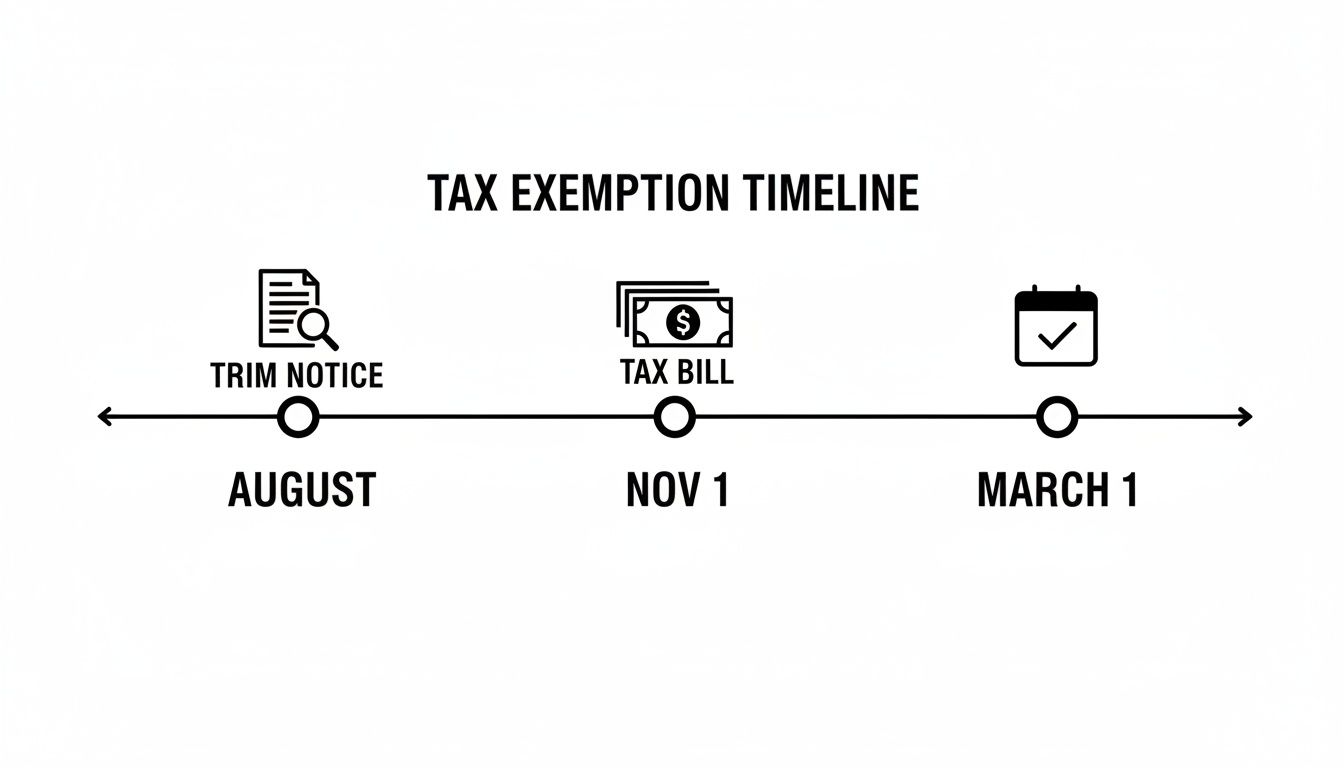
Seeing the entire tax year laid out visually really helps clarify when you need to act, whether it's to appeal your assessment or to grab those early payment discounts.
November to March: Paying Your Tax Bill
Around November 1st, the official, final tax bills are mailed out by the Volusia County Tax Collector. This is the real deal, reflecting the certified millage rates that fund our local services in Port Orange and New Smyrna Beach.
In fact, these tax collections are a vital part of funding the county for its 568,229 residents (as of 2023). Under state law, you are responsible for paying this bill even if you never receive the notice in the mail. You can see how Florida's data portal tracks these collections for all counties.
Now for the good part: Volusia County offers a fantastic incentive for paying your bill early.
Volusia County Early Payment Discount Schedule
The county rewards property owners who pay ahead of schedule with a tiered discount system. It’s a straightforward way to keep a little more of your hard-earned money.
The final deadline to pay without any penalties is March 31st. After that, your taxes become delinquent, and interest and other fees start to pile up.
Taking advantage of that 4% discount in November is one of the smartest financial moves a homeowner can make all year. It’s like getting a guaranteed return on your money.
How Property Taxes Play Out When You Buy or Sell
When you're in the middle of a real estate transaction in Port Orange or New Smyrna Beach, property taxes are a huge detail that can't be ignored. For both buyers and sellers, knowing how taxes are handled at the closing table—and what comes next—is key to avoiding nasty surprises and making sure your budget is on solid ground.
At closing, Volusia County property taxes are always prorated. Think of it like splitting a utility bill; the seller pays for the days they owned the home that year, and the buyer picks it up from the closing date forward. This calculation is all sorted out by the title company, ensuring everyone chips in their fair share.
For Sellers: Your "Save Our Homes" Benefit Stays With You
If you've owned your Port Orange or New Smyrna Beach home for a while, you've likely benefited from the Save Our Homes (SOH) cap, which limits how much your assessed value can increase each year. Here's the critical thing sellers need to understand: that benefit is yours and yours alone. It doesn’t transfer to the new owner.
The moment the property is sold, that accumulated tax savings you've built up over the years vanishes for that property. The tax slate is essentially wiped clean for the next owner.
For Buyers: Brace Yourself for the "Tax Shock"
This brings us to the single biggest financial trap for homebuyers. It's incredibly tempting to look at the seller's current tax bill on the MLS listing and plug that number into your mortgage calculator. Don't do it. Your tax bill will be different, and almost certainly higher.
Once the sale is recorded, the Volusia County Property Appraiser will reassess the home's value, bringing it up to the current market value—which is closely tied to what you just paid for it. This reassessment means your property taxes, especially in the second year you own the home, can jump significantly. I've seen it cause real budget stress for unprepared buyers in both Port Orange and New Smyrna Beach.
Pro Tip: Never, ever base your long-term housing budget on the seller's old tax bill. Always estimate your future taxes based on your purchase price to get a realistic picture of your monthly payment.
This is something I walk all my clients through. We run the numbers based on reality, not the seller's artificially low bill, so there are no "gotchas" a year down the road.
A Homebuyer's Ace in the Hole: Portability
Now for some good news. While you can't take over the seller's SOH savings, you might be able to bring your own with you. If you're moving from another homesteaded property in Florida, you can transfer your accumulated SOH benefit to your new home in a process called portability.
It’s a game-changer, and here’s the gist of how it works:
- You have to establish your new homestead within three tax years of leaving your old one.
- You can "port" up to $500,000 of that tax-saving benefit.
- If you're downsizing to a less expensive home, you can only port a percentage of the savings.
Portability is one of the best tools Florida homeowners have for managing their Volusia County property taxes over the long haul. It's not automatic, though—you have to apply for it. I always make sure my clients who are eligible know exactly how to take advantage of this powerful savings opportunity.
Common Questions About Volusia County Property Taxes
When it comes to property taxes, the devil is often in the details. Let's tackle some of the most common questions I hear from homeowners in Port Orange and New Smyrna Beach to clear up any confusion.
Why Did My Taxes Go Up If My Assessment Was Capped?
This is a big one, and it catches a lot of people by surprise. You're looking at your tax bill, knowing your Save Our Homes cap prevented your assessed value from jumping more than 3%, yet the total amount due is higher. What gives?
Remember, your tax bill is a two-part equation: your property's value and the tax rates (millage). Even with your assessment capped, your bill will climb if the millage rates set by the county, the City of Port Orange, or the City of New Smyrna Beach go up. Think of it this way: they're taking a slightly bigger slice of the same (or slightly larger) pie, which results in a larger final bill.
What Happens If I Miss the March 1st Homestead Deadline?
Missing that March 1st deadline to file for your Homestead Exemption is a costly mistake. If you miss it, you simply have to wait until the next year to apply and get those savings. While there's a late-filing period, you have to prove there was a really good reason you couldn't file on time, which can be tough.
My advice? Don't even risk it. Mark your calendar and file on time. Missing the deadline can easily cost you hundreds, if not thousands, of dollars.
Is Market Value the Same as Assessed Value?
Not at all, and this difference is where the real benefit of homeownership in Florida kicks in, especially for long-time residents.
- Market Value: This is simple—it’s the price your New Smyrna Beach home could likely sell for on the open market today. It's what a buyer is willing to pay.
- Assessed Value: This is the value the county uses for tax purposes. For properties with a Homestead Exemption, its annual increase is capped, meaning it often lags far behind the true market value over time.
This gap between what your home is worth and what you're taxed on is one of the biggest financial advantages for Florida residents.
Do I Reapply for My Homestead Exemption Every Year?
Here's some good news: no, you don't. Once you've successfully filed for your Homestead Exemption, it automatically renews every year as long as you continue to own and live in the home as your permanent residence. Your savings and your Save Our Homes cap stay protected without you having to lift a finger.
Understanding the nuances of property taxes is crucial when you're navigating the real estate market in Port Orange or New Smyrna Beach. At Robert Kirkland - REMAX Signature, I make it my job to provide the expertise you need for informed, confident decisions. Whether you're a first-time buyer or a seasoned investor, I'm here to help.
Visit my website to start your journey with confidence.
Important: This is educational, not professional tax or legal advice.
I am Robert Kirkland, a licensed Florida REALTOR® with REMAX Signature — not a CPA, tax attorney, or licensed insurance agent. Every property tax situation has individual nuances that this guide cannot fully cover. Before making decisions based on this post, verify your specific parcel data at vcpa.vcgov.org and consult a qualified tax professional, attorney, or financial advisor for advice tailored to your circumstances.
Exemption amounts ($26,411 additional homestead in 2026, $38,686 senior exemption income limit in 2026) are adjusted annually by Volusia County and the Florida Department of Revenue. The Volusia County Property Appraiser publishes current figures each tax year.
Related Reading: Volusia County Real Estate Decisions
Property taxes are one piece of the Volusia County buying decision. These newer guides dig into the related decisions about which city to buy in and what to do if financial pressure surfaces:
Deltona Short Sale Specialist: Sell Your Florida Home Before Foreclosure
The Save Our Homes tax reset discussed in this guide is one of the main pressures driving Deltona homeowners into financial distress. If you’re behind on payments or considering selling for less than owed, this 2026 guide walks through your short sale options step by step.
Port Orange vs Ormond Beach: Which Volusia City Is Right For You? (2026)
Detailed 2026 comparison including the meaningful city millage difference (Port Orange 4.8567 vs Ormond Beach 4.0894), school zones, gated golf communities, and lifestyle. For families and retirees deciding between these two Volusia favorites.
Port Orange vs Daytona Beach: Where Should You Buy in 2026?
Same county, two very different buyer profiles. Covers the ~1.2 mill city tax difference, insurance variances, school zones, and which city fits your situation after 50+ Volusia transactions.
The Kirkland Coastal Assessment Protocol (KCAP)
Property tax is just one cost layer. The KCAP framework walks through how to evaluate flood zone, wind insurance, storm surge, and elevation risk on any coastal Volusia property before you write an offer.
12-page pre-offer / pre-listing pricing tool covering FEMA flood zones, roof-age carrier tiers, wind mitigation credits, 4-point inspection red flags, and a fillable worksheet. The same framework Robert runs as KCAP for his clients — free, no obligation.
Get The Worksheet →Related guide: How to File Your Volusia Homestead Exemption — the step-by-step that locks in the savings covered above.
Robert Kirkland is a licensed Florida REALTOR® specializing in coastal Volusia County real estate. He works exclusively in the seven coastal cities plus DeLand, Deltona, and Oak Hill — Port Orange, New Smyrna Beach, Daytona Beach, Daytona Beach Shores, Ormond Beach, Ponce Inlet, Edgewater, and South Daytona — with deep submarket knowledge of Spruce Creek Fly-In, The Loop, LPGA / Indigo, Plantation Bay, Venetian Bay, Coronado, and Riverwalk.
He runs the proprietary Kirkland Coastal Assessment Protocol (KCAP) on every buyer transaction — a three-part flood-zone, insurance-cost, and storm-surge analysis completed before his clients go under contract. It's the difference between buying a coastal Florida home and being surprised by carrying costs, vs. buying it knowing exactly what you're walking into.
Track record: 50+ historical transactions · 29 recent listings sold · 22-minute average lead response time · Out-of-state buyers helped from 22 states in the past 24 months.
Licensed in the State of Florida · Member, National Association of REALTORS® · Stellar MLS (Daytona Beach Area Association of REALTORS®)
Questions about your specific tax situation?
Homestead, portability, CDD fees, the Save Our Homes reset — I help Volusia buyers and owners sort it out every week.
Book a Free 15-Min Consult →Buying in the Daytona Beach area? Don’t get caught by the tax reset.
I’m Robert Kirkland — 50+ Volusia closings. Before you make an offer, I’ll show you the true annual carrying cost (taxes + insurance) — not the seller’s capped bill.