How to Negotiate a Home Price Like a Pro
Updated September 2026 with MLS data through August 2026.
You can't win a negotiation if you show up unprepared. The real work of buying a home starts long before you ever make an offer. Getting your ducks in a row first is what separates a successful, confident buyer from one who leaves money on the table.
Think of it as building your case. You need the evidence, the financial backing, and the right team on your side. This groundwork gives you leverage and credibility, turning you from a hopeful house hunter into a serious buyer that sellers can't ignore.
See homes for sale in Volusia County right now
Listings change weekly. Browse what is on the market today, updated in real time:
Browse Volusia County Homes →Building Your Foundation for a Strong Negotiation

Before you fall in love with a property, you need to arm yourself with knowledge, financial power, and professional support. Success here isn’t about luck; it's about doing the homework so you can make smart, data-driven decisions when it matters most.
This prep phase is what gives you a real seat at the table. It’s about looking past the asking price to find a home's true market value, proving to sellers you’re a sure bet, and getting an expert team in your corner.
Analyze the Local Market Like an Expert
You absolutely have to know the local market, whether you're eyeing a beachfront condo in New Smyrna Beach or a family home in Port Orange. Asking prices are just a starting point—often, they're just what the seller hopes to get.
The best way to get grounded in reality is with a Comparative Market Analysis, or CMA. Your real estate agent will pull this for you, and it’s the most powerful tool you have at this stage.
A solid CMA breaks down the most important data points:
- Recently Sold "Comps": These are the gold standard. You're looking at what similar homes (in size, age, condition, and location) have actually sold for. This is the truest indicator of value.
- Active Listings: This is your current competition. Seeing what else is for sale helps you understand how much wiggle room you might have.
- Expired Listings: These are the homes that sat on the market and didn't sell, usually because they were overpriced. They're a great reality check, showing you the price ceiling the market won't tolerate.
Broader market conditions also play a huge role. Locally, the numbers back that up. Across Volusia County the median sale price was $340,000 in August 2026, unchanged from a year earlier, and the median listing took 92 days to sell (MLS data through August 2026). When homes sit that long, many sellers are willing to negotiate. You can learn more about these housing market trends and projections to see how they might affect your strategy.
Secure Your Financial Leverage with Mortgage Pre-Approval
Showing up to a negotiation without a mortgage pre-approval is like trying to play poker without any chips. It's a non-starter.
A pre-approval letter is a formal document from a lender confirming they're willing to loan you a specific amount. This is a big step up from a simple pre-qualification; it means they've already vetted your finances—credit, income, the works.
A pre-approval letter transforms you from a "window shopper" into a "serious contender" in the seller's eyes. It proves you have the financial backing to close the deal, immediately increasing your credibility and bargaining power.
A seller will almost always take a solid offer from a pre-approved buyer over a slightly higher one from someone whose financing is a question mark. You're removing a massive piece of risk for them, which makes your offer instantly more appealing.
Assemble Your Professional Negotiation Team
You don’t have to go it alone, and you shouldn't. A small but skilled team is your secret weapon.
A Savvy Real Estate Agent: This person is your frontline negotiator and strategic advisor. In a market like Volusia County, a local agent knows the neighborhoods, has relationships with other agents, and can spot trends before they become obvious. They do way more than just open doors; they craft the offer, manage the back-and-forth, and keep the deal on track.
A Thorough Home Inspector: Think of the inspector as your property detective. They’re trained to find the hidden problems—a failing AC unit, a subtle roof leak, or outdated wiring. Their report isn't just a list of flaws; it's a powerful tool for a second round of negotiations after your offer is accepted. Significant issues found during the inspection are prime opportunities to ask for repairs, a credit at closing, or a straight price reduction.
Before you jump into making offers, it's smart to review these core preparation steps. Each one is a building block that strengthens your position.
Your Pre-Negotiation Power Checklist
This quick checklist summarizes why these initial steps are so crucial for giving you an edge.
Getting these four things locked down puts you in the driver’s seat. You'll be negotiating from a place of confidence and strength, not desperation.
Making Your First Move: How to Craft a Winning Offer
Think of your first offer as the opening move in a chess match. It's not just a number; it's a strategic play that tells the seller you're serious, you've done your homework, and you're ready to talk. The goal isn't to land an unbelievable steal with a lowball offer—that's a quick way to get your offer tossed in the trash. Instead, you want to present a compelling case that invites a counteroffer and kicks off a real conversation.
This is all about striking a delicate balance. Your offer needs to be grounded in the home's real market value (which you know from your CMA), factor in any glaring issues you've already spotted, and even take a calculated guess at the seller's motivations. A well-crafted offer gets a response, not a rejection.
How to Land on That Perfect Starting Number
Deciding on that initial price is part art, part science. You're blending the hard data you've gathered—the comps, how long the house has been sitting, its condition—with a bit of market intuition. Lean on your agent here; they live and breathe this stuff and can help you read between the lines.
When you're figuring out what to offer, you'll want to weigh a few key things:
- The Real Comps: How does the list price stack up against what similar homes actually sold for recently? If the comps are coming in lower, your offer should, too.
- Days on Market (DOM): Across Volusia County the median listing took 92 days to sell in August 2026 (MLS data through August 2026), so a house that has been lingering well past that gives you a lot more leverage than one that just hit the market last Thursday. A seller's patience (and price flexibility) often wanes over time.
- The Home's Condition: Did you spot a roof that looks like it's on its last legs or a kitchen straight out of the 80s? You'll have to sink money into those things, and your offer should reflect that from the start.
That first number you put down has a big psychological impact. In a typical, balanced market, coming in 5-10% below the asking price is often a solid opening move, especially if you have the data to back it up. For instance, on a home listed at $400,000, if your research shows its true value is closer to $385,000, an initial offer of $375,000 isn't insulting—it's a confident, well-reasoned start.
More Than Just a Price: Structuring an Offer That Protects You
The price gets all the attention, but the terms of your offer are arguably more important. This is where your contingencies come in. Think of them as your "get out of jail free" cards—clauses that let you walk away from the deal with your earnest money deposit if something goes wrong.
Your offer isn't just about what you're willing to pay; it's about the terms under which you're willing to pay it. Strong contingencies protect your financial interests and give you critical leverage points for future negotiations.
These three are the non-negotiables. They are standard for a reason and are absolutely vital for protecting yourself as a buyer:
- Inspection Contingency: This gives you a window of time (usually 7-10 days) to bring in a professional inspector. If they uncover a cracked foundation or a faulty electrical system, this clause lets you renegotiate, ask for repairs, or walk away completely.
- Financing Contingency: This is your safety net in case your mortgage doesn't get final approval. If, for some reason, the bank pulls your funding, this ensures you won't lose your deposit.
- Appraisal Contingency: This one is huge. It stipulates that the home must appraise for at least what you've agreed to pay for it. If the appraiser says it's worth less, you're not on the hook to cover the difference; you can renegotiate or cancel the contract.
A Quick Look at Negotiation Styles Elsewhere
It's interesting to see how local customs shape negotiations around the world. In Australia, for instance, property auctions are incredibly common, which completely changes the game. Research on how auctions influence housing price negotiations shows that smart buyers sometimes try to sidestep the bidding wars by making a strong offer before the auction date. While we don't see that much in Volusia County, it’s a good reminder of how much market dynamics can dictate strategy.
Ultimately, your opening offer sets the tone for everything that comes next. When you anchor your price in solid data and build a strong defensive wall with the right contingencies, you show the seller you're a serious, savvy buyer. You're not just starting a negotiation; you're taking control of it from a position of strength.
Handling Counteroffers and Seller Concessions
Don't panic when you get a counteroffer. It's not a rejection—it’s an invitation to talk. This is great news. It means the seller is serious, and the real negotiation is just getting started. This back-and-forth is where you'll find the sweet spot that works for everyone, and it often involves a lot more than just the price.
Think of the seller's counter as their next move on the chessboard. Your job is to figure out what they truly value and make a smart, strategic move of your own.
Decoding the Seller's Counteroffer
When a seller counters, they're giving you clues about what matters most to them. Did they only bump up the price? That tells you they're laser-focused on their bottom line. Did they accept your price but ask to change the closing date? That’s a huge signal that their timeline is the top priority, maybe to line up with buying their next place or getting kids settled before school starts.
Understanding their motivation is your secret weapon. Your real estate agent is your MVP here; they can often get the inside scoop from the seller's agent. For instance, if a seller has already bought another home, they're probably feeling the pressure to close fast. That gives you leverage to push back on the price if you can offer them the quick, clean closing they need.
To figure out your next move, you have to weigh a few key factors.

As you can see, every good negotiation strategy is built on a foundation of solid research, a clear-eyed look at the home's condition, and a smart read on the seller's urgency.
Negotiating Beyond Price with Seller Concessions
Sometimes, a seller just won't budge on their price. But that doesn't mean the negotiation is over. This is where seller concessions can save the day. In short, these are closing costs the seller agrees to pay for you, which directly reduces the cash you need to bring to closing.
Honestly, most buyers would rather have cash in their pocket now than a slightly lower monthly payment over 30 years. Let's run the numbers on a real-world scenario:
- The Situation: The seller counters your offer at $410,000, but your target was $400,000. Your estimated closing costs are around $8,000.
- Your Next Move: Instead of countering on price again, you agree to their $410,000 price but ask for an $8,000 credit toward your closing costs. The seller gets the sale price they wanted, and you just saved $8,000 in out-of-pocket cash. It’s a win-win.
A quick heads-up: lenders cap how much a seller can contribute, usually a percentage of the loan amount. So, always run this by your mortgage provider first. It's a common and effective tactic—more than 50% of buyers successfully get some kind of seller concession.
The goal is to find a solution where everyone walks away feeling good. If you can give the seller something they value (like their asking price or a flexible close date), you’ll be in a much stronger position to ask for something you value, like help with closing costs or a home warranty.
Advanced Tactics for a Competitive Market
When the market is hot and you know you're up against other buyers, you need to pull out the advanced plays. An escalation clause can be an incredibly powerful tool when you’re heading into a bidding war.
Here’s how it works: an escalation clause automatically increases your offer by a specific amount over any higher competing offer, up to a maximum price—your "cap"—that you set. For example, you could offer $400,000 with a clause that beats any other offer by $2,000, all the way up to a cap of $415,000.
This sends two powerful messages to the seller:
- You are absolutely serious about their home.
- You're willing to pay fair market value, but you aren't going to get caught up in the frenzy and overpay.
Use this one carefully, though. You’re basically showing the seller all your cards, including the maximum you're willing to pay. This is a tactic reserved for true multiple-offer situations, and you'll need to lean on your agent's local expertise to know if it's the right call.
By reading the counteroffer, getting creative with concessions, and knowing when to use advanced tactics, you can navigate this final stretch like a pro and land a deal you're happy with.
Using Inspections and Appraisals as Leverage
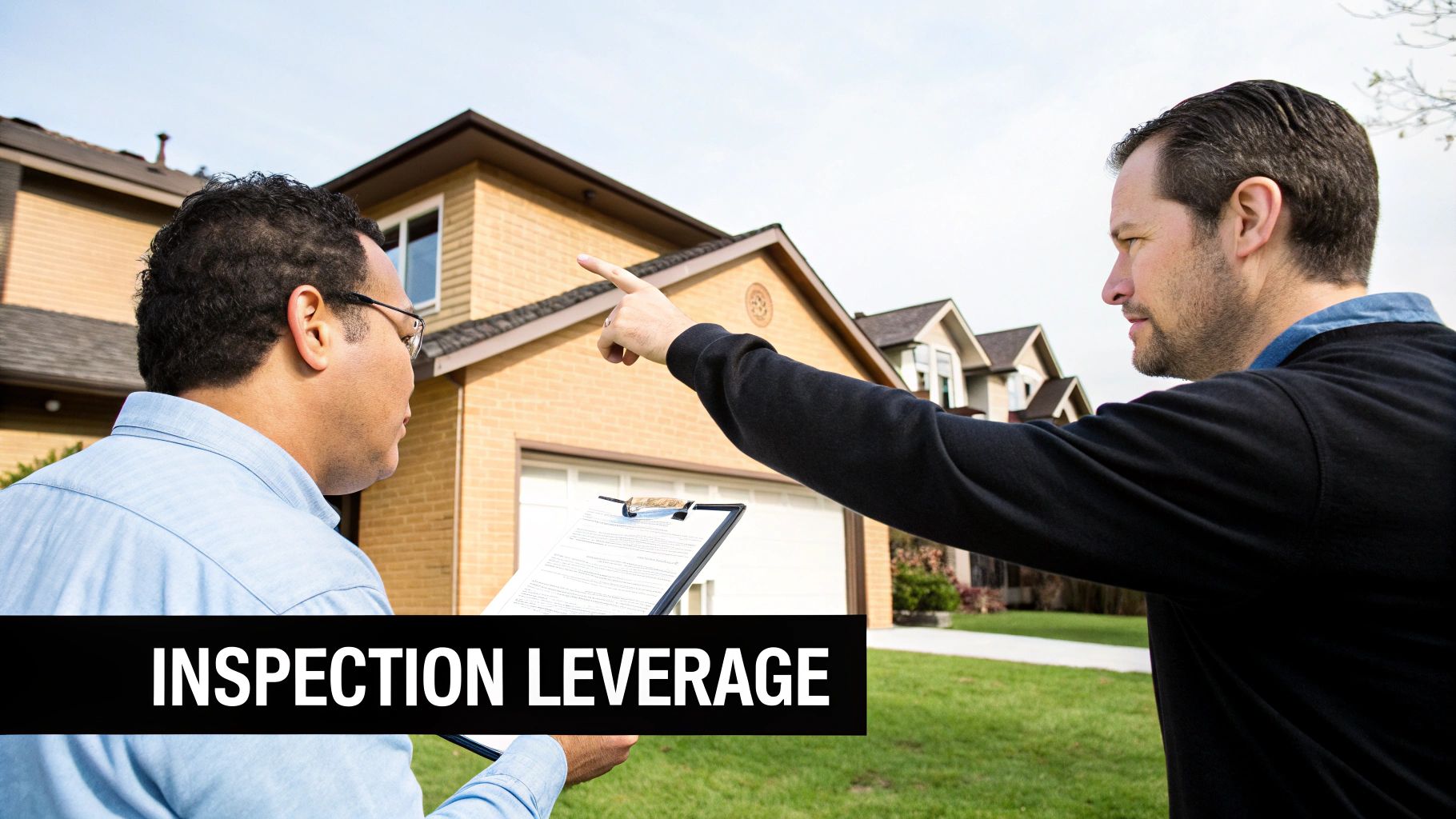
Getting your offer accepted feels like crossing the finish line, but in reality, you've just entered a new phase of negotiation. This is where the home inspection and appraisal reports come into play, and they are arguably your most powerful tools.
These aren't just boxes to check on the way to closing. They are impartial, expert assessments that shift the conversation from what you think to what is known. Armed with these reports, your requests for adjustments are based on hard data, not just emotion.
Turning the Inspection Report into a Negotiation Tool
Let’s be clear: the home inspection is going to find problems. It always does. Even in a well-maintained home, there will be a list of items. Your job isn't to nitpick every loose doorknob or scuffed wall—that just alienates the seller.
Instead, zero in on the big-ticket items that affect the home's safety, structure, or major operational systems. These are the issues that give you real bargaining power.
I'm talking about things like:
- HVAC Systems: Is the air conditioner on its last legs? A full system replacement is a huge expense you don't want to inherit without compensation.
- Roofing Problems: Any sign of active leaks or a roof that's at the end of its lifespan is a major red flag, often a five-figure fix.
- Electrical Concerns: An outdated panel or faulty wiring isn't just an inconvenience; it's a serious safety hazard.
- Plumbing Issues: We're not talking about a leaky faucet. Think major pipe leaks or, worse, sewer line problems that can cost a fortune to repair.
When the report flags these kinds of issues, you've got three ways to play it: ask the seller to make the repairs, request a credit to cover your closing costs, or negotiate a straight-up price reduction.
Here’s a pro tip: more than 50% of the time, savvy buyers negotiate for closing cost credits instead of having the seller do the work. This puts cash back in your pocket and lets you hire contractors you trust, on your schedule.
This is often the cleanest path for everyone. The seller doesn't have to manage contractors, and you get complete control over the quality of the repair. For instance, if the inspector flags a roof repair estimated at $7,000, asking for a $7,000 seller credit is a simple, effective solution.
Here’s a quick guide on how to approach different inspection findings.
Inspection Findings Negotiation Scenarios
Remember, your goal is to address significant, unforeseen costs—not to get a perfect house.
What to Do When the Appraisal Comes in Low
The bank's appraisal is its own form of due diligence. They need to make sure the property is worth what they're lending you. If the appraisal comes in below your offer price, your appraisal contingency is your get-out-of-jail-free card.
Imagine you've offered $420,000, but the official appraisal values the home at just $410,000. That $10,000 difference is the "appraisal gap." Your lender won't finance that gap, which means you're on the hook for it unless you negotiate.
You have a few ways to handle this:
- Renegotiate the Price: This is your first move. Present the appraisal to the seller and request they drop the price to the appraised $410,000. It’s a powerful argument because the seller now knows any other buyer with a mortgage will likely run into the same issue.
- Split the Difference: A good compromise can save the deal. You might offer to bring an extra $5,000 in cash to closing if they reduce the price by $5,000.
- Cover the Gap: If it's your dream home and you have the funds, you can simply pay the $10,000 difference out of pocket.
- Walk Away: This is your last resort, but the appraisal contingency protects you. You can cancel the contract and get your earnest money deposit back, no strings attached.
A low appraisal puts a lot of pressure on the seller. They can either work with you or risk putting the house back on the market with a new, lower valuation hanging over it. This gives you fantastic leverage to get the price right.
Closing the Deal and Knowing When to Walk Away
You’ve made it this far. You’ve navigated the offers, the back-and-forth, the inspection reports, and now you’re nearing the finish line. As you approach the closing table, this is where the details—and your nerve—truly matter. The final stage is all about holding your ground, making sure every last detail is perfect, and having the courage to walk if the deal just isn’t right.
The biggest mistake I see buyers make at this point is letting their emotions get the best of them. After weeks, sometimes months, of searching and negotiating, it's so easy to get attached. But this is exactly when you need to stay objective. Thinking like a businessperson right now is what will protect your financial future.
Get It All in Writing
Let me be crystal clear: if it's not in writing, it didn't happen. In real estate, verbal promises are worth the paper they’re written on—which is to say, nothing. Before you sign a single closing document, you and your agent need to comb through that final contract with a fine-tooth comb.
This final check is your last line of defense. It ensures every single point you negotiated is documented and correct. Did the seller agree to that $5,000 credit for the old HVAC system? Is the closing date exactly what you agreed to? Are the specific appliances you wanted explicitly listed? A small oversight here can become a massive headache—and a huge, unexpected expense—the day you move in.
Defining Your Walk-Away Point
Way back before you even thought about making an offer, you should have set your absolute maximum price. This isn’t just a number you feel good about; this is your non-negotiable walk-away point. It's the price where the house stops being a good investment for you, no matter how perfect the kitchen is.
Sticking to this number is one of the toughest things you’ll do, but it's the core of smart negotiation. It’s incredibly easy to get swept up in a bidding war or feel pressured to stretch your budget "just a little bit more." Resist that urge. A house that puts you in a financially precarious position isn't a dream home; it’s a liability waiting to happen.
Your walk-away point is your ultimate power move. It gives you the confidence to negotiate from a position of strength and the freedom to say "no" to a deal that doesn't serve you. Remember, walking away from a bad deal isn’t failure—it's the most strategic decision you can make to protect your biggest asset.
The Broader Market and Your Leverage
Don't forget that your personal negotiation doesn't happen in a vacuum. Larger economic forces play a huge role in how much leverage you have. For example, rising interest rates tend to cool down hot housing markets, shifting power back toward buyers.
In the first quarter of 2024, real house prices globally actually fell by 1.0% year-over-year. In some major European markets, nominal prices dropped for the first time in over a decade simply because fewer buyers could get mortgages. Less competition means more power for you. You can read up on these global residential price developments to get a sense of how these larger trends might be trickling down to our local market. Closer to home, Volusia County had 5.67 months of housing supply in August 2026, down from 7.78 a year earlier. That is still enough inventory to give buyers real leverage, just a little less than last year (MLS data through August 2026).
When Is It Time to Walk Away?
Sometimes, no matter how hard you try, a deal just isn't meant to be. Pulling the plug on a negotiation isn't a loss; it's a savvy business move when the risks start to outweigh the rewards.
Here are some tell-tale signs that it’s time to move on:
- Major Inspection Surprises: The inspector finds something serious—structural problems, major electrical issues, or environmental hazards like mold or foundation cracks—and the seller flat-out refuses to fix it or offer a fair credit.
- The Appraisal Gap Is Too Big: The official appraisal comes in way under your offer price, and the seller won't budge. You should never be the one footing the bill for a home's inflated price tag.
- The Seller Is Unreasonable: They won't negotiate in good faith, start making bizarre demands at the last minute, or drag their feet on critical paperwork. These are red flags that could signal bigger problems down the road.
- You've Hit Your Limit: The final numbers push you past your walk-away point. If the deal threatens your financial stability, it’s not the right deal.
Trust me on this: another house will always come on the market. Protecting your investment by walking away from a bad deal is the smartest negotiation you’ll ever make. It ensures that when you finally do close, it’s on a home that is a true win for you.
Got Questions About Negotiating on a House? We’ve Got Answers.
Even the most prepared home buyers run into questions once the negotiation process kicks off. It's totally normal. Getting straight answers can give you the confidence you need when the pressure is on.
Let's walk through some of the most common questions I hear from buyers, from what really makes an offer a "lowball" to surviving the heat of a bidding war.
What’s Actually Considered a Lowball Offer?
It’s a common misconception that a "lowball offer" is just a certain percentage below the list price. The real definition has everything to do with the market data, not a random number.
An offer isn't a lowball just because it's 15% or 20% below asking. It becomes a lowball when it completely ignores what similar homes (comps) in the neighborhood have recently sold for.
For instance, offering $350,000 on a home listed at $425,000 sounds aggressive on the surface. But if your agent's research shows that nearly identical homes nearby have sold for around $360,000, your offer is actually well-reasoned and backed by data. It's a strategic starting point, not an insult.
So, How Much Below Asking Should I Really Offer?
There’s no magic formula here—it really depends on the current market, the condition of the house, and how motivated the seller is. Think of it as a sliding scale.
- In a Buyer's Market: When there are plenty of homes for sale and not enough buyers, you’ve got the upper hand. Starting 5% to 10% below the list price on a fairly priced home is a pretty standard opening move.
- For a House That Needs Work: If the inspection reveals a leaky roof or the kitchen is a total gut job, your offer needs to reflect those big-ticket costs. A lower offer isn't just justified; it's expected.
- In a Seller's Market: When competition is fierce, forget about big discounts. You often have very little room to negotiate down. In these situations, offering at or even slightly above the asking price might be what it takes to get your foot in the door.
Your real estate agent is your secret weapon here. They have their finger on the pulse of the local Volusia County market and can guide you toward an opening offer that’s both aggressive enough to save you money and strong enough to be taken seriously.
Help! How Do I Handle a Bidding War?
Bidding wars are intense, but the key is to stay cool and strategic. The very first thing you need to do is decide on your absolute maximum price—your "walk-away" number—and promise yourself you won't go a penny over it. Emotions can make you do crazy things with your money.
An escalation clause can be a great tool in this scenario. It automatically increases your offer by a set amount (say, $2,000) over any competing bid, but only up to your pre-set cap. It shows the seller you're serious without forcing you to just guess at the highest possible number.
Remember, the highest price doesn't always win. You can make your offer stand out in other ways, like offering a quick closing, putting down a larger earnest money deposit, or dropping non-essential contingencies. Sometimes, convenience is more valuable to a seller than a few extra thousand dollars.
Can I Negotiate Again After the Home Inspection?
You bet. The inspection isn't just a pass/fail exam for the house; it’s your built-in second chance to negotiate. In fact, it’s estimated that more than 50% of real estate deals involve another round of negotiations based on the inspection report.
My advice? Focus only on the big stuff—health, safety, or major system failures—not chipped paint or a loose doorknob. And instead of asking the seller to make the repairs (they'll almost always pick the cheapest fix), it's usually smarter to ask for a credit toward your closing costs. That way, you get the cash to hire a contractor you actually trust to do the job right.
Navigating a real estate negotiation takes local know-how and a sharp advocate on your side. At Robert Kirkland - REMAX Signature, I bring the data-driven advice and tough negotiation skills you need to win in Port Orange, New Smyrna Beach, and Daytona Beach. Ready to buy or sell with confidence? Let's connect. Find out more at https://www.robertsellsdaytona.com/.
Questions about Volusia County? Let me help.
I know this market street by street. Tell me your budget and must-haves and I will point you to the right fit.
Book a Free 15-Min Consult →