Updated September 2026 with MLS data through August 2026.
When you're mapping out the budget for your new home, most people focus squarely on the down payment. But there's one last financial hurdle to clear before you get the keys: the closing costs. These are all the fees required to finalize the deal, and they typically add up to 3% to 5% of the home's purchase price.
What Are Closing Costs and Why They Matter
Think of closing costs as the administrative and legal wrap-up of your home purchase. It's the collection of fees paid to all the different professionals who play a role in making the transaction happen—from the lender who finances the deal to the title company that ensures the property is legitimately yours.
These costs aren't just random fees; they pay for essential services that protect you, the seller, and the lender. Getting a handle on them early in the process is crucial. It prevents last-minute financial surprises and ensures you walk into your closing appointment feeling prepared, not panicked.
See homes for sale in Volusia County right now
Listings change weekly. Browse what is on the market today, updated in real time:
Browse Volusia County Homes →The Purpose Behind the Fees
So, what exactly are you paying for? It helps to break down closing costs into a few key buckets:
- Lender Fees: Your mortgage lender has to do a lot of work to approve and create your loan. These fees cover their services, like underwriting (the deep dive into your finances) and loan origination (the administrative work of putting the loan together).
- Third-Party Fees: A whole team of independent professionals is involved in your purchase. This category covers their work, including the home appraisal, title search, credit report, and more.
- Government Fees and Prepaids: This bucket includes costs required by your local government, like recording fees to officially document the sale. It also covers "prepaids"—items you pay for in advance, like your first year of homeowners' insurance and a few months of property taxes.
Setting a Realistic Budget
Budgeting for these costs is non-negotiable. Here in the U.S. and in most major markets, that 3% to 5% range is a reliable rule of thumb. This figure covers everything from lender charges and title insurance to taxes. Of course, the exact amount can shift based on your location, the specific terms of your loan, and local taxes. For a deeper look at what today's buyers are facing, you can find some great data in this recent report on aspiring homeowners.
Let's put that into perspective. For a $354,000 home here in Florida, which is the Volusia County median sale price year to date (MLS data through August 2026), you should be prepared for closing costs somewhere in the ballpark of $10,620 to $17,700. That's a serious chunk of change you'll need on top of your down payment.
Once you understand what these costs are and why they exist, they stop being a source of anxiety and become just another part of the home-buying checklist. In this guide, we'll give you a clear roadmap to understanding, estimating, and even lowering these final expenses, so you can head to the closing table with total confidence.
An Itemized Breakdown of Common Closing Costs
When you first lay eyes on your Closing Disclosure, it’s easy to feel overwhelmed. The document is packed with line items, financial jargon, and numbers that can make your head spin. But don't think of it as some dense legal text. It’s better to view it as a detailed receipt for one of the biggest purchases of your life. Every single fee is there for a reason, and getting a handle on them is the key to closing with confidence.
To get started, it helps to group these costs into three main buckets: fees that go to your lender, fees for third-party services, and costs required by the government.
This simple chart shows who all the key players are that you'll be paying at the closing table.
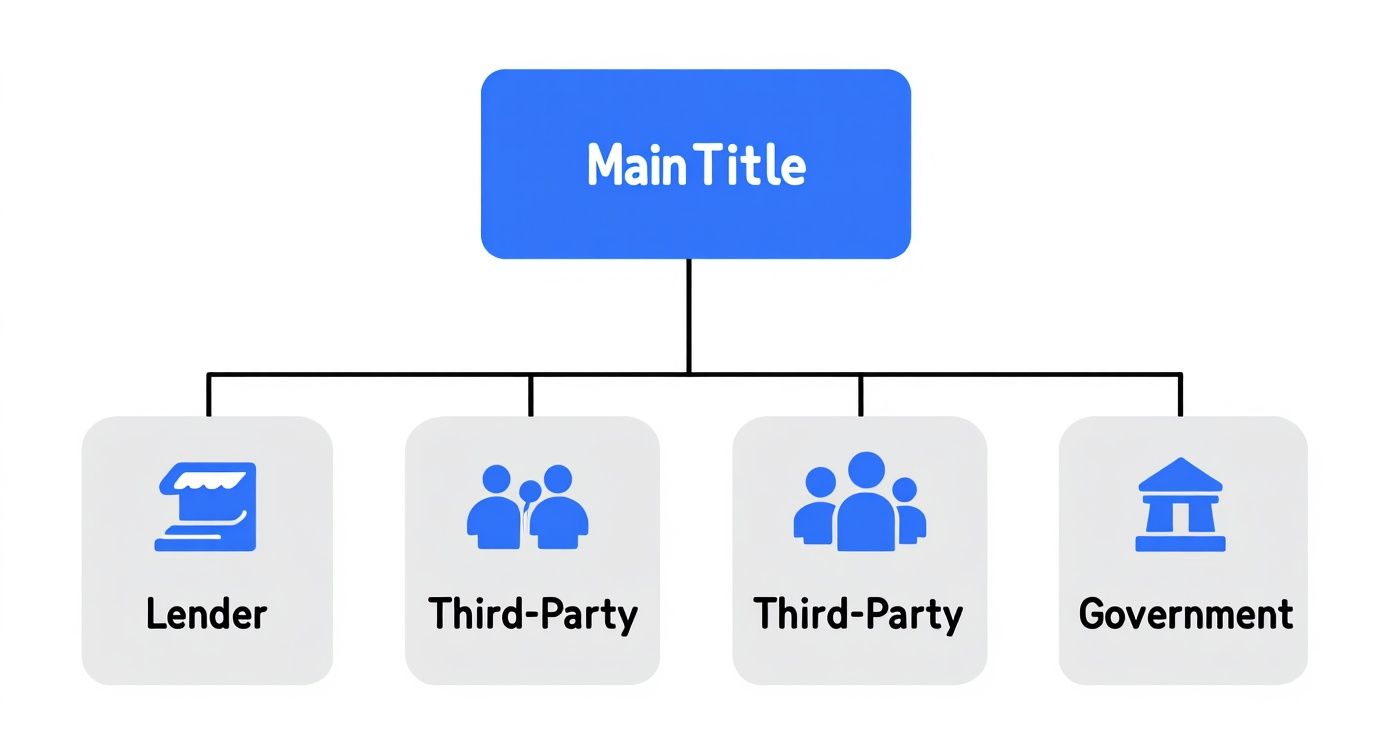
As you can see, the money doesn't just go to one place. It’s spread out across your mortgage provider, independent professionals, and government agencies—each providing an essential service to make your home purchase official and secure.
Lender and Loan-Related Fees
The first set of costs is all about the mortgage itself. Your lender does a lot of heavy lifting to verify your finances, process your application, and ultimately provide the massive loan that makes buying a home possible. These fees are how they get paid for their work and the risk they’re taking on.
You’ll typically see charges like these:
- Loan Origination Fee: This is what the lender charges for the administrative work of preparing and processing your loan. It’s usually a percentage of the total loan, often somewhere between 0.5% and 1%.
- Underwriting Fee: Underwriting is the real financial deep-dive. It's the process where the lender scrutinizes your income, assets, debt, and credit history to officially approve you. This fee covers the cost of that intense evaluation.
- Discount Points: This one is completely optional. You can choose to pay "points" upfront to "buy down" your interest rate, which in turn lowers your monthly mortgage payment. One point will almost always cost 1% of the loan amount.
- Credit Report Fee: A small but necessary charge. The lender has to pull your credit history from the major bureaus to see how you’ve handled debt in the past. This usually costs between $30 and $50.
These fees are a big reason why shopping around for your mortgage is so important. A few hundred dollars' difference in origination or underwriting fees can really add up.
Third-Party Service Fees
It takes a village to close on a house. Beyond your lender, a whole team of independent professionals gets involved to make sure the transaction is buttoned up and legitimate. As the buyer, you’re the one who pays for their expertise. Think of it as an investment in protecting yourself and the lender from problems down the road.
Think of third-party services as your home-buying due diligence team. From the appraisal to the title search, each service provides a crucial layer of verification and protection for what is likely your largest financial investment.
Here are the key third-party fees you'll encounter:
- Appraisal Fee: A licensed appraiser gives an independent, professional opinion on what the property is worth. Lenders demand this to make sure they aren’t lending you more money than the home is actually worth. In our area, this fee is typically $300 to $600, depending on the home’s size and complexity.
- Title Search and Insurance: This might be one of the most important protections you buy. A title company digs through historical records to ensure there are no hidden claims, liens, or ownership disputes on the property. You'll pay for that research, plus two insurance policies: a lender's policy (which is mandatory) and an owner's policy (which is highly recommended) to protect your claim to the property forever.
- Home Inspection: While a lender might not always require it, you should never skip it. A professional inspector walks through the property to find any structural problems, safety issues, or big-ticket repairs hiding in plain sight. The cost for a good inspection usually runs from $350 to $700.
- Survey Fee: Sometimes, a survey is needed to officially map out the property lines and identify any issues, like a neighbor's fence encroaching on your yard. This is especially common with single-family homes.
These fees go to neutral, unbiased professionals whose job is to ensure every detail of the property and transaction is verified.
Government Fees and Prepaid Expenses
The last bucket of costs covers government taxes and recording fees, plus a few items you have to pay for in advance. These are generally non-negotiable amounts set by state and local laws.
First, the government charges:
- Recording Fees: Your local government, like the Volusia County Clerk of Court, charges a fee to legally record the new deed and mortgage in the public record. This is what makes your ownership official.
- Transfer Taxes: In Florida, we call these "doc stamps." It's a tax the state and county charge on the transfer of property from one owner to another.
Next up are the "prepaids," which are exactly what they sound like. You're paying for certain expenses up front, and the money is held in a special account called an escrow account, managed by your lender.
- Prepaid Homeowners Insurance: Lenders will require you to pay for your first full year of homeowners insurance at or just before closing.
- Prepaid Property Taxes: You'll also need to prepay a few months' worth of property taxes. This money sits in your escrow account so the lender can pay the tax bills on your behalf when they're due.
- Prepaid Interest: This covers the mortgage interest that accrues from the day you close until the end of that month. Because of this, closing at the very end of the month can slightly lower the amount of cash you need to bring to the table.
Once you understand where the money is going, the Closing Disclosure starts to look less like an intimidating document and more like a simple checklist on your path to getting the keys.
Estimating Your Closing Costs with Real Numbers
Alright, let's move past the theory and talk about what this actually means for your wallet. When you're budgeting for a home, knowing what you might really pay in closing costs is absolutely critical. The most common rule of thumb you'll hear is that closing costs for home buyers typically fall between 2% and 5% of the home's final purchase price.
Think of that percentage as your starting point for financial planning. It’s a wide range for a reason—several key factors can push your final number toward the lower or higher end of that spectrum. Knowing what these variables are helps you get a much better sense of where your own costs might land.
What Pushes the Needle on Your Total Costs?
Not all closing cost bills look the same. A few key things have a direct impact on that final figure you’ll see on your Closing Disclosure.
- Property Location: This is a big one. Fees and taxes vary wildly from state to state, and even county to county. Here in Florida, for instance, we have "doc stamps" on the deed and mortgage—a major cost that buyers in many other states never even see.
- Your Loan Type: The kind of mortgage you get really matters. FHA and VA loans come with their own unique funding fees and insurance rules that are quite different from a Conventional loan.
- Your Choice of Lender: Lenders don't all charge the same origination and underwriting fees. This is exactly why it pays to shop around and compare the official Loan Estimates from at least three different lenders before you commit.
- The Home's Price: It’s simple math, really. Since many costs are a percentage of the purchase price, a more expensive home will naturally have higher closing costs.
A Real-World Example in Volusia County, Florida
Let's ground this with a concrete example. Say you're buying a $354,000 home right here in Volusia County, the county's median sale price year to date (MLS data through August 2026). Applying our 2-5% range, you should prepare for closing costs somewhere between $7,080 and $17,700.
So, why the huge $10,000+ gap? It all comes back to those variables we just talked about. If you secure a loan with low lender fees and negotiate for the seller to cover some costs, you might land closer to that $7,080 mark. On the other hand, if you have a more complex loan type or are buying in an area with slightly higher tax rates, your costs could easily creep toward the higher end of that range.
To give you some perspective, a 2024 national study found that the average closing costs for homebuyers in the U.S. were around $4,661, or 1.06% of the sale price. But be careful with that number—it's heavily skewed by states that don't have significant transfer taxes like Florida does. This just goes to show how vital local expertise truly is. You can discover more insights about these national closing cost trends to see how different regions stack up.
Sample Closing Cost Estimate (Based on a $354,000 Home in Florida)
To pull it all together, let’s look at a sample breakdown for that same $354,000 home in our area. This table gives you a much clearer picture of where the money goes and the potential range for each of the most common fees you'll run into.
As you can see, even with a detailed breakdown, your final number will be unique to your situation. The only way to get a truly accurate figure is to get a Loan Estimate from your lender. That document gives you a personalized, line-by-line breakdown of every single charge they anticipate.
How to Navigate Your Closing Disclosure Form
About three days before you get the keys to your new home, a very important document is going to land in your inbox: the Closing Disclosure, or "CD" as we call it in the business. Don't let the official-looking, five-page format intimidate you. Think of it as the final, itemized receipt for your home purchase. Its whole purpose is to show you every single cost and credit, spelling out the final loan terms so there are no last-minute surprises at the closing table.
https://www.youtube.com/embed/B5cJEcRu-aA
By law, your lender has to get this to you at least three business days before you sign the final paperwork. This is a non-negotiable "cooling-off" period. It’s designed to give you time to breathe, review everything carefully, ask questions, and feel 100% confident in the numbers before you commit.
Comparing Your Closing Disclosure and Loan Estimate
The first thing you should do is pull up the Loan Estimate (LE) you received when you first applied for the loan and place it side-by-side with your new Closing Disclosure. The LE was the lender's educated guess of your costs, while the CD is the final, locked-in reality. In a perfect world, they’d look almost identical.
But some numbers can shift a bit, while others are legally forbidden from changing at all. It’s crucial to know which is which.
- Zero Tolerance Fees: These costs can't increase, period. This includes the lender's origination fee and any discount points you paid to lower your interest rate. If these numbers are higher on the CD, you need to flag it immediately.
- 10% Tolerance Fees: This bucket covers third-party services your lender required you to use, like the appraisal and credit report. The total cost for these items can’t jump by more than 10% from what was quoted on your Loan Estimate.
- Unlimited Tolerance Fees: Some costs have more wiggle room. Fees for services you shopped for yourself—like homeowners insurance or the title company—can change. Things like prepaid interest and your initial escrow deposit can also adjust based on your exact closing date.
If you spot a big difference, don't panic. Just pick up the phone and call your loan officer or your real estate agent. Ask them to walk you through the changes, line by line, until it makes sense.
Key Sections You Cannot Afford to Skim
Every page of the CD is important, but a few key sections deserve your laser focus. Knowing where to look helps you quickly confirm the most critical details of the deal.
First, turn your attention to Page 1. This is the high-level summary.
- Loan Terms: Double-check the final loan amount, your interest rate, and the monthly principal and interest payment. Does this match what you agreed to?
- Projected Payments: This table gives you the full picture of your estimated monthly payment, including principal, interest, mortgage insurance, and the escrow amounts for property taxes and homeowners insurance.
- Cash to Close: This is it—the big one. This is the exact amount of money you need to have ready for closing.
The total Cash to Close is the bottom-line figure that tells you how much money you'll need to wire or bring as a cashier's check. This number should be very close to what you were expecting based on your Loan Estimate and recent discussions with your lender.
Next, flip to Page 2, where you'll find the nitty-gritty breakdown of all your closing costs. This is the itemized list of every single fee, from what the lender is charging to title services and government taxes. It's here you can really compare each line item against your Loan Estimate and spot any discrepancies.
It's no secret that these costs have been on the rise. According to the Consumer Financial Protection Bureau (CFPB), the median loan costs for buyers hit $5,954 in 2022, a pretty significant 21.8% increase from the year before. Much of that jump came from title insurance, appraisals, and credit reports. You can discover more about these closing cost findings to see the national trends, which really highlights why reviewing Page 2 is so important for today's buyers.
Finally, on Page 3, find the "Summaries of Transactions" table. This section works like a balance sheet for the whole deal, showing all the debits (what's owed) and credits (what's been paid) for both you and the seller. It confirms the final sales price, accounts for your earnest money deposit, and lists any seller concessions you negotiated. Making sure these figures are correct is your final check, as they directly impact your final Cash to Close amount. Going through your Closing Disclosure with a fine-toothed comb is the last step toward a smooth, confident closing day.
Practical Strategies to Lower Your Closing Costs
While closing costs are a standard part of buying a home, that final number isn't necessarily set in stone. The truth is, you have more control than you might think. With some smart planning and a little bit of negotiation, you can actively chip away at these expenses and keep more cash in your pocket on closing day.
One of the most powerful tools you have is negotiating for seller concessions, which you'll also hear called seller credits. This is simply a deal where the seller agrees to pay a portion of your closing costs. It's a surprisingly common strategy, especially in certain market conditions, and it can dramatically lower the amount of money you need to bring to the closing table.
Let’s say your closing costs are estimated to be $12,000. You could structure your offer to ask the seller to contribute $5,000 toward that bill. If they agree, that $5,000 is credited directly to you at closing, meaning you only need to come up with the remaining $7,000. Just keep in mind that lenders often cap the amount of seller concessions based on your loan type, so it’s a conversation you need to have with your agent and lender early on.
Shop for Your Services
Here’s a secret many buyers miss: you can shop around for some of the biggest closing cost items. Your lender will give you a list of their go-to providers for certain services, but you are absolutely not required to use them. A little comparison shopping here can lead to big savings.
- Lenders: Get a Loan Estimate from at least three different lenders. Don't just look at the interest rate; compare the fees they charge for originating, underwriting, and processing the loan. A 0.5% difference in an origination fee on a $354,000 loan saves you $1,770 right off the bat.
- Title Companies: The cost for a title search and title insurance can vary quite a bit from one company to the next. Get a few quotes from local title agencies to make sure you’re getting a fair price for this essential protection.
- Homeowners Insurance: Don't just take the first quote you get. This premium is one of your major prepaid costs, so it pays to shop around, ask about bundling with your auto insurance, and look for any available discounts.
Remember, your power to save lies in comparison. By taking the time to shop for these big-ticket items, you are directly influencing some of the largest variable costs on your Closing Disclosure.
Make Tactical Financial Decisions
Beyond shopping and negotiating, a few other savvy moves can help trim your final bill. It often comes down to timing your closing wisely and understanding the trade-offs your lender can offer.
First, pay close attention to your closing date. If you can, schedule it for the end of the month. Doing so shrinks the amount of prepaid interest you owe. This fee covers the daily interest from your closing day through the end of that month. A closing on the 28th means you only pay for a few days, while closing on the 2nd means you're paying for almost an entire month.
Another option to discuss with your lender is lender credits. In this scenario, the lender agrees to pay for some or all of your closing costs. The catch? You accept a slightly higher interest rate on your loan. This can be a fantastic move if you're short on cash for closing, but you need to do the math to see how that higher rate impacts your payment and total cost over time. It’s a trade-off that really depends on your financial goals and how long you see yourself in the home.
Think of Us as Your Guide Through Florida's Closing Costs
When you really get down to it, understanding closing costs is all about turning a big, intimidating number into a series of smaller, manageable pieces. It’s about swapping anxiety for confidence. Once you can see exactly what makes up that final figure—the lender fees, the third-party charges, the government taxes—you can budget effectively and face that Closing Disclosure without a shred of doubt. It all comes down to preparation.
Remember, national averages are interesting, but they don't tell your story. The only numbers that truly matter are the ones specific to Florida, your lender, and your unique deal. This is exactly where having a local expert in your corner makes all the difference. A great agent doesn’t just unlock doors to houses; they help you build a smart financial game plan from the very beginning.
Your Local Volusia County Expert
Figuring out the closing costs for home buyers in places like Ormond Beach, Daytona Beach, or Port Orange is a local game. It requires knowing which lenders have a reputation for fair fees and, just as importantly, how to structure an offer that gets the seller to help cover some of your costs.
I’m Robert Kirkland with REMAX Signature, and I live and breathe this stuff. My entire goal is to make sure there are no last-minute financial surprises when you get to the closing table. From introducing you to trusted local title companies to meticulously reviewing your settlement statement line by line, I'm here to provide the hands-on support you need.
A great real estate agent isn’t just a salesperson; they’re your financial advocate, helping you see around corners and make decisions that protect your investment for years to come.
If you're ready to start seriously thinking about homeownership in Volusia County, let’s connect. Contact me, Robert Kirkland, today for a no-pressure consultation. We'll map out what your closing costs could look like and build a strategy to get you into a home you love, with a price tag you can feel good about.
Got Questions? We’ve Got Answers
Even after breaking it all down, there are always a few lingering questions that pop up. That’s perfectly normal. Let's tackle some of the most common ones I hear from buyers so you can walk into closing day with total confidence.
Can Closing Costs Be Rolled Into the Mortgage?
This is the big one, and the answer is a classic "it depends." With most conventional loans, you can't just tack the closing costs onto your loan balance. However, there's a workaround: lender credits. You can opt for a slightly higher interest rate, and in return, the lender gives you a credit that covers a chunk (or sometimes all) of your closing fees.
Some government-backed loans are a bit more direct. VA loans, for instance, let you finance certain closing costs, and FHA loans have their own rules for rolling the mortgage insurance premium into the loan. It's all about what type of financing you're getting.
So, When Do I Actually Pay All This?
You'll settle up on your closing day. This is the big meeting where you sign the final stack of papers and officially get the keys. But don't worry, you won't be writing a dozen different checks. It all gets bundled into one final figure called your "cash to close."
You’ll see this exact number on your Closing Disclosure a few days beforehand. To pay it, you'll need to arrange a wire transfer or get a cashier's check from your bank. Personal checks just aren't an option for a transaction of this size.
Are My Closing Costs Tax-Deductible?
For the most part, no, but a few specific items might give you a small tax break. Think of it this way: the fees you pay to get the loan (like origination or appraisal fees) are not deductible. But the costs related to the property itself often are.
Here’s what you can usually deduct:
- Mortgage Interest: Any prepaid interest you cover at closing.
- Property Taxes: Your share of the property taxes for the year.
- Discount Points: If you paid points to "buy down" your interest rate, those are typically deductible.
Heads Up: I'm a real estate pro, not a tax advisor. Tax laws are tricky and can change, so you should always chat with a qualified tax professional to see exactly what you can deduct based on your own situation.
What If I'm Paying Cash? Do I Still Have Closing Costs?
You bet, but they’ll be a whole lot less. When you pay with cash, you get to skip all the lender-related fees. That means no loan origination, underwriting, or lender-required appraisal fees, which cuts out a huge chunk of the cost. (Though I still strongly recommend getting your own appraisal to protect your investment!)
You'll still be on the hook for the other essential services, though. Things like the title search, owner’s title insurance, government recording fees, and prorated property taxes are all part of a cash deal. These steps are crucial for making sure the property transfer is legal and secure.
Making sense of closing costs in the Volusia County market is so much easier when you have an expert in your corner. If you want personalized guidance on your home purchase, give me a call. I’m Robert Kirkland at REMAX Signature, and I’m here to help you build a smart financial plan for your move.
https://www.robertsellsdaytona.com/
386-631-5107
Questions about Volusia County? Let me help.
I know this market street by street. Tell me your budget and must-haves and I will point you to the right fit.
Book a Free 15-Min Consult →